

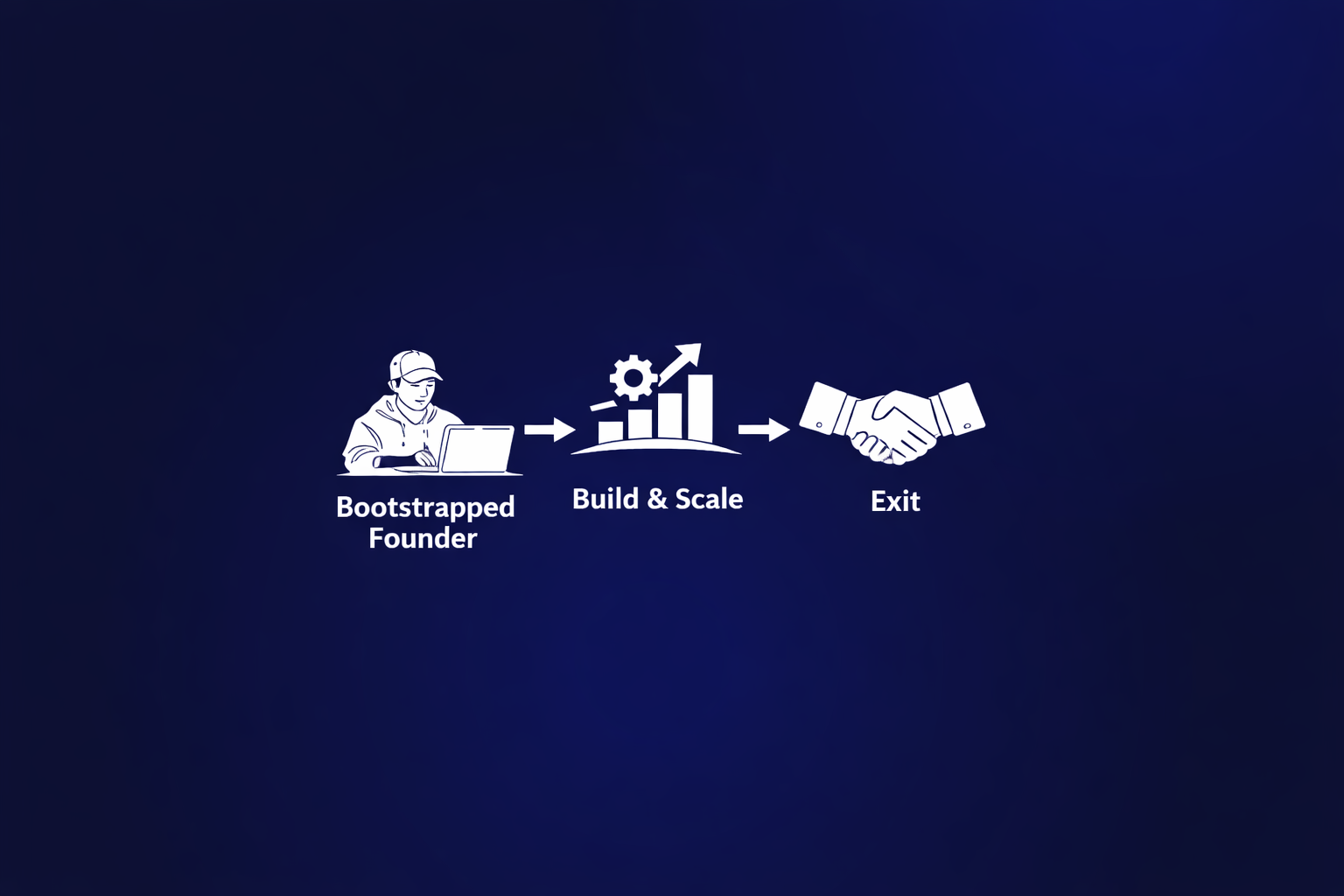
Bootstrapped SaaS founders build on revenue from day one, instead of fast-tracking growth through VC-backed dilution. The result is often something institutional buyers actively seek: healthy EBITDA margins, loyal customers, clean cap tables, and a business that generates real cash. Yet many founders who have spent years running a disciplined operation underestimate how different selling a company is from building one.
The M&A market for SaaS remains active despite the volatility that has rattled public software valuations in the last few weeks. Just take a look at the data: enterprise SaaS M&A in Q3 2025 alone rivalled the activity records of 2021, with deal volume surging more than 26% quarter-over-quarter.
Demand from both private equity and strategic acquirers is strong. The question is rarely whether a well-run bootstrapped SaaS business can find a buyer. It is whether the founder understands the market, knows where the company stands, and is positioned to run a process that produces the best outcome.
This article covers why bootstrapped businesses attract serious buyers, which metrics drive conviction and valuation, and what a structured sell-side process looks like when it works.
Why buyers value bootstrapped SaaS companies
Private equity firms and strategic acquirers look for businesses with durable cash flows, efficient growth, and limited execution risk. Bootstrapped SaaS companies often check every one of those boxes.
Clean cap tables simplify deal mechanics. There are no preference stacks, no conflicting investor rights, and no governance friction to negotiate around. From a buyer’s perspective, that alone removes a meaningful source of complexity.
The profitability signal matters too. Bootstrapped SaaS businesses tend to run lean by design: hiring is deliberate, spending is tied to returns, and margins are often higher than VC-backed peers.
On multiples, SaaS Capital’s 2025 data puts bootstrapped private SaaS at 4.8x ARR on average, compared to 5.3x for equity-backed peers.
That said, aggregate multiples like these carry limited precision, since deal-level outcomes vary significantly based on growth profile, retention, market timing, and buyer type. What the gap in that data point does reflect is illiquidity and scale, not quality. Smaller private companies may trade at a discount to larger peers regardless of business model. That multiple compression generally comes from deal size and market exposure, not from how the business was built or how well it performs. And because bootstrapped founders typically own 80 to 100% of their business versus 25 to 40% for VC-backed founders, a lower headline multiple can still translate into significantly more cash in the founder's pocket at close.
Overall, predictable recurring revenue, capital-efficient growth, and founder alignment all reduce the risk profile of these bootstrapped businesses in the eyes of buyers. That is why demand is consistent even in more selective markets.
What “fast” means in M&A
Most founders who want to sell quickly assume speed means finding one interested buyer, often someone who has already reached out, and moving fast. That is not a fast process. It can be an unstructured one, and unstructured processes are where timelines slip and founder burnout takes hold.
A well-prepared, competitive sell-side process with qualified buyers and organized documentation typically runs around six months from launch to close. Reactive or informal processes routinely extend well beyond that, precisely because friction accumulates at every stage: in diligence, in negotiation, and in closing.
Buyer type affects speed
Not all buyers move at the same pace, and understanding the difference matters when structuring a process. Private equity firms are acquisition machines. They have dedicated deal teams, in-house legal and financial diligence capabilities, and clear investment mandates. Once conviction is established, they can execute quickly. PE buyers captured two-thirds of all enterprise SaaS deal value in Q3 2025, a dramatic shift from the historical norm where corporate acquirers led, and PE-led enterprise SaaS deals hit a quarterly record in Q1 2025.
Strategic acquirers, by contrast, often require board approval for acquisitions above certain thresholds and frequently outsource portions of technical or commercial diligence to external advisors. That adds time. Their motivations are also different: they are buying for product fit, market access, or competitive positioning, not purely for financial returns. Understanding the buyer universe before you go to market directly affects how you sequence outreach and manage timelines.
Running a process that includes both buyer types creates competitive tension between different valuation frameworks: a PE firm’s returns-driven pricing against a strategic’s synergy-driven premium. That tension is one of the most reliable ways to improve both price and speed.
[Read: Financial vs. strategic buyers: choosing the right fit for your SaaS]
The metrics that drive buyer conviction
Buyers move faster when risk is lower. Risk is lower when the financial story is clean, consistent, and supported by data. For SaaS and bootstrapped companies, the following four metrics carry particular weight:
1. Net Revenue Retention is the first thing sophisticated buyers look at after ARR. Companies with NRR above 120% can command two to three times the valuation multiple of comparable businesses below 100%. NRR above 100% signals that existing customers are expanding their spend, which means the business can grow without relying entirely on new customer acquisition. That is a fundamentally different risk profile. What constitutes a strong NRR depends on your segment and price point, but the signal is consistent across buyers. We cover the benchmarks and what buyers actually look for in our breakdown of NRR for SaaS companies.
[Read: NRR in SaaS: What Is It and Why It Matters for a Tech Business?]
2. The Rule of 40 is a second key screening metric. Companies that clear the threshold, where growth rate plus profit margin equals or exceeds 40, consistently attract stronger buyer interest. Bootstrapped companies have a structural advantage here: profitability is often the default operating mode, so even moderate growth rates can push founders past the threshold.
[Read: SaaS and the Rule of 40: From Metric to Mindset]
3. Customer concentration is the metric that most often surprises founders. If a single customer accounts for more than 10% of ARR, expect buyers to apply a discount, ask for longer earn-outs, or request escrow provisions. Think of it from a risk perspective: if that one customer drops, the company just lost a significant amount of its income. Hence, diversification across the customer base directly reduces perceived revenue risk.
[Read: Customer concentration risk: impact on your SaaS valuation]
4. CAC payback periods under 12 months validate that the go-to-market engine is efficient and scalable. Founder dependency is the last variable buyers assess in this category: businesses where the founder is the primary sales relationship, the product vision, and the operations lead all at once raise continuity questions that require either a longer transition period or structural deal provisions.
Bootstrapped SaaS businesses often score well across all four of these metrics by default. The discipline that comes from building without external capital (controlled burn, deliberate hiring, customer-funded growth) tends to produce exactly the financial profile buyers find most convincing.
The fastest way to sell a bootstrapped SaaS company
The fastest path to a close is structured and deliberate, not simply opportunistic or reactive. Founders who sell efficiently share a common pattern: they started preparing before they were ready to sell.
Preparation begins with a realistic valuation analysis, one grounded in current market data and your specific metrics rather than headlines from 2021. It includes building clean financial summaries that reconcile ARR, MRR, and EBITDA with no ambiguity in how numbers are defined. It means organizing a data room before the first NDA is signed, not after.
Outreach should also be targeted and competitive, not broadcast. A curated list of qualified strategic and PE buyers, run through a time-bound process with coordinated IOI deadlines, creates the pricing tension that drives both valuation and timeline. Prepared sellers close 30 to 40% faster than unprepared sellers. The math is simple: buyers who find what they need quickly develop conviction quickly.
What slows things down almost always traces back to the same three sources: incomplete or inconsistent financial reporting that triggers extended diligence, heavy founder dependency that raises continuity concerns and forces earn-out structures, and the absence of competing buyers that removes urgency and pricing leverage.
Preparation drives valuation and timing
Bootstrapped SaaS founders often enter a sale process with structural advantages: strong margins, clean ownership, loyal customers, and a business that has survived on its own merit. Those qualities matter to buyers. But they do not automatically produce a fast or well-priced outcome.
Diligence has a way of surfacing issues that day-to-day operations can hide, such as revenue recognition policies that do not hold up, customer dependencies that were not visible in aggregate metrics, or financial reporting inconsistencies that create hesitation and unwanted, unexpected, risk for the buyer.
The deals that close efficiently are almost always prepared well before acquirers and investors are contacted.
If you are considering a sale in the next twelve to twenty-four months, contact L40° to start a confidential conversation about how to position your business for the best possible outcome.


.png)


